Monday, November 12, 2012

"Fooling Houdini" by Alex Stone

Like many, I suppose, I had a very brief flirtation with magic as a kid. I must have received the magic kit for a birthday (it seems like a grandparent gift) sometime in elementary school, and I spent some time fooling with the plastic magic wand and other assorted tricks the box contained. At some point I reached an unwarranted level of confidence and even put on a show for my neighbors--albeit a show where one trick actually required the audience to close their eyes as I made a ball "disappear" by hiding it behind the grill. That show was the end of my magic career.

Nonetheless, in Fooling Houdini, Stone has a point when he argues that magic is something that appeals to many of us, as audience or performer, but that there's something special in being able to fool and delight another person. With that in mind, Fooling Houdini explores various wide-ranging topics related to the fooling and delighting that is magic: early and modern con games; the psychology of fooling; the magic of mindreading; the importance of touch in performing magic; the importance placed on secrecy; the shuffle; the role of mathematics. The book isn't always completely focused (it reminded me some of Ronson's The Psychopath Test in that way), but it is interesting. Stone also reveals the processes behind a number of magic tricks (mostly card tricks, his specialty), which I enjoyed, as I agree with Stone that knowing the science behind a trick doesn't diminish the awe of seeing it performed any. For me the parts focused on magic specifically were more interesting than the chapters on psychology only because I've read so many other books (Thinking Fast and Slow, Moonwalking with Einstein, The Mind's Eye) that address the psychology of the human mind more thoroughly.

Once I finished, the book Fooling Houdini reminded me the most of was Foer's Moonwalking with Einstein, which is even mentioned and referenced in Stone's book. Like Foer, Stone begins and ends his book with a competition--a memory competition for Foer, a close-up magic competition for Stone. Both men also center their books and their exploration of their topics through the personal lens of training and improving their craft. For this reason, almost as much of Fooling Houdini is about Stone's personal quest to find his place as a magician as it is about magic in general. Depending on how much you invest in Stone's journey may affect how much you enjoy the book; I found his personal story a bit uninteresting in the beginning, though it grew on me by the end.

Though the book is probably too simplistic for people who have studied magic or psychology, it is an easy dip into many of the unknowns related to magic.

Sunday, November 4, 2012

"Midnight's Children" by Salman Rushdie

The basic premise of Rushdie's Midnight's Children sounds almost like it could be a YA fantasy/dystopian novel (admittedly, a surprisingly worldly and non-European YA given the current state of the genre): on midnight the day of India's independence from Britain, several hundred babies, "midnight's children," are born. Each of these children is endowed with a special gift or power, none more so than the two male babies born right at midnight: Saleem and Shiva. Unbeknownst to either boy or either boy's family, the two babies are switched shortly after birth by a kind-hearted but wrong-headed nurse. Narrated by Saleem, Midnight's Children follows the boy as he grows up and discovers his powers of telepathy and his ability to communicate with and bring together, in his mind, all of midnight's children. As Saleem's life mirrors the development of India as a country, his life also irrevocably heads toward confrontation with Shiva, his rival.

Although I knew going in that this wasn't going to be an action-oriented kid-with-powers adventure, I guess part of me hoped that Midnight's Children would, I don't know, be an interesting mash-up of fantasy and history, YA and political understanding. After all, Rushie's Luka and the Fire of Life, which I enjoyed,  had that kind of tone. Instead, Midnight's Children is magical realism, history, and stream of consciousness in the most annoying way possible.

I've never enjoyed the South American magical realists, and if I thought that Indian magical realism would somehow be different, I was wrong. Midnight's Children takes place firmly in the real world; there are weird coincidences and odd characters, but almost no fantasy. Though Saleem can, at various points in his life, enter others' minds or smell emotions, neither skill figures much into the book. Instead, most of the novel is a very slow exploration of his childhood. This might have been tolerable if the novel wasn't narrated by Saleem's adult self. Saleem the narrator constantly stops the book to interrupt, to backtrack, to spend pages and pages on Indian history that he sees as influenced by his life and then to foreshadow ominously the book's ending. Though part of the book's conceit is that Saleem sees his life and India's life as intertwined, it's very difficult for someone with little knowledge of Indian history to follow (that's certainly a problem with me as a reader, not Rushdie as a writer, but it was nonetheless an issue for me). The constant foreshadowing of doom was tiresome; either leave it be, or get on with it!

For fans of magical realism (if you, ahem, somehow enjoyed One Hundred Years of Solitude), pointless constant foreshadowing by an excessively involved narrator (e.g., Book Thief), and books of enormous length and casts of characters, Midnight's Children is probably a great choice.

Sunday, October 28, 2012

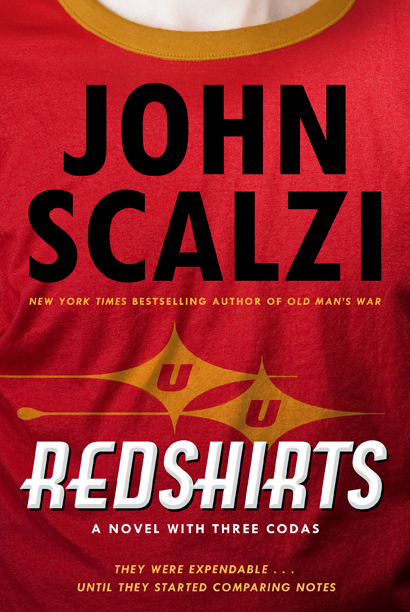
"Redshirts" by John Scalzi

Redshirts should be right up my alley: sci-fi! humor! action! The book is based on the tendency of Star Trek to kill off random unnamed characters (wearing redshirts) in whatever conflict of the week was occurring. In his book, Scalzi takes these unnamed redshirts and makes them his main characters, then follows them as they begin to realize the extraordinarily high death toll of low-level crew members who go on away missions. Though I'm no Trekkie, I grew up watching Star Trek: The Next Generation with my family, and I'm a fan of more current sci-fi space shows like Battlestar Galactica. So, it was especially disappointing when Redshirts was such a let down.

First, the characters. Though there are a number of "redshirt" characters, they're virtually indistinguishable from each other. Each is given a basic back story (Dahl studied at a religious order; Duvall is a flirty and forward woman), but that back story never plays a role in what they say or how they act. Though some of their interchangeability could be blamed on their very existence as redshirts (who are, of course, completely interchangeable), that explanation doesn't make the book any more fun to read. Without caring about the characters, I'm not going to buy a story.

Secondly, almost the entirety of the book is dialogue. I actually began hoping for a paragraph of description. Instead, it's constant speech as characters expose and discuss what's happening. And, because the characters are virtually interchangeable, so is their dialogue. As names popped up of who was speaking, I had to pause and try to remember who each person was. Nothing about one character's speech distinguished him or her from any other character.

As the book hurtled toward its end, things became more and more unbelievable (which, again, I suppose could be some sort of meta-commentary on the state of poor sci-fi--but that still doesn't make the book better!). The number of people who rather easily believed that fictional characters were alive and visiting them was rather staggering. And, since I didn't care nor could I distinguish the characters, it didn't really matter to me if everything turned out right.

Once the story ends, the book itself doesn't end, but instead continues with three unnecessary "codas" about other characters. The first is utterly dull, the second is vaguely interesting but unimportant, and the third makes little sense other than providing an expected happy ending.

There was some great opportunity for parody and satire in Redshirts that is wasted, though the book does a good job of pointing out some of the funnier tropes used in space sci-fi. There was room to explore some issues around that. Why do we rely on silly tropes? Why can't we create drama without death? But, Scalzi largely ignores these issues to instead create a fast-paced and mostly hollow novel.

I feel like I've said this several times recently, but I think Redshirts would work better as a movie. The pacing might feel less frenetic, and it would help to have visuals on each character in order to distinguish them. But, until the movie comes out, I'd skip the book.

Saturday, October 27, 2012

"Gone Girl" by Gillian Flynn

Gone Girl seems to have been the hot book of the season (when I first requested it at the library, I was number 900-something on the waiting list), and it's easy to see why: it's a mystery, psychological thriller, and CSI/Law & Order episode all in one. The premise is that Nick's wife Amy disappears the morning of their fifth wedding anniversary, and soon signs point to Nick as a murderer. In alternating chapters with Nick's narration of the present and Amy's diary entries of the past, the reader learns about their imploding marriage while uncovering what really happened that morning.

The book is divided into three sections, and I was totally hooked in the first. Amy and Nick were very much real people--albeit seriously flawed people who were tearing one another apart--and you could see how their marriage might have arrived at the point it did. I could identify with Amy's early "pretending" in the relationship, feigning being the "cool girl" (the girl who looks great without trying; who doesn't mind when her boyfriend/husband blows her off; the girl who's up for pizza and beer and football and never insists on doing those "girly" things) because she wants Nick to like her and she wants them to have a good relationship. And I could also understand Nick, who often felt like a failure and ended up blaming Amy, regardless of her role in the matter. They were still awful people to each other most of the time, but there was human-ness in their feelings and behavior.

In this first section, there's lots of excitement and tension as more and more is revealed. It's clear that both Amy and Nick are, to some extent, unreliable narrators, which constantly kept me guessing about what really happened. In fact, I was so excited, I emailed my sister and recommended the book to her when I was barely half way through.

However, my enthusiasm dimmed some by the second section. (SPOILERS AHEAD) Instead of both Amy and Nick seeming real but flawed, Amy turns out to be absolutely nuts. I no longer was reading a book about a troubled marriage gone very wrong; instead I was reading a cable criminal drama (which had borrowed liberally from Sleeping with the Enemy) about a psychopath. Once this section opens, much of the mystery is gone.

The third section brings in a final disappointing twist: both Amy and Nick are nuts. Certifiably crazy. Though the ending was quite creepy, it was also unsatisfying after all the early build up.

I think I'd still recommend the book, even though the end half of the book didn't live up to the first half.

Sunday, October 21, 2012

"Let's Pretend This Never Happened" by Jenny Lawson

Though I'd never heard of Jenny Lawson or her blog before, Let's Pretend This Never Happened came on my radar as a funny memoir, so I was game. The book covers Lawson's childhood in Texas with her taxidermist father and patient mother through her marriage to Victor and the birth of her child Hailey. Each chapter is a new story, most of which are centered on her family's strange habits, Lawson's anxiety and OCD, and her absurd arguments with her husband.

On the down side, you can see the blog origins of Lawson's writing. Some of the stories and particularly the style can get repetitive, especially Lawson's hyperbole about injuries and fear of death. But, then, I was often laughing out loud and even reread portions of chapters to my husband--so all that previous stuff didn't really matter. I think I was most hysterical during her OD'ing on laxatives/rapist in the bathroom story, though her anecdotes from her time in HR were also fabulous. Helpful photos accompany the stories, which are always appreciated.

Let's Pretend This Never Happened isn't great writing, but it is funny, especially if you empathize with or, perhaps, occasionally share Lawson's quirks.

Friday, October 12, 2012

"Tell the Wolves I'm Home" by Carol Rifka Brunt

I usually turn my nose up at contemporary fiction that deals with relationships and families, thinking it will be boring and uninteresting. But then I read a book like Tell the Wolves I'm Home and realize that a novel that's (on the surface) about a lonely teenage girl can be just as engaging as science fiction and fantasy.

Tell the Wolves I'm Home follows the relationship between fourteen-year-old June and the adult Toby. June is a loner and rather weird: she's obsessed with the middle ages (she often goes into the woods to pretend she's back in time) and is deeply (and secretly) in love with her Uncle Finn. Toby is Finn's boyfriend and the person June's family blames for giving Finn AIDS. When Finn dies, June is heartbroken, but she and Toby slowly start to find happiness through their friendship with one another.

What I really loved about the book is that it's so messy. June is in love with her uncle, even if she doesn't want to admit it, and she doesn't know how to deal with feelings she knows are wrong. And her relationship with Toby, while different, is hardly any more appropriate. They drink and smoke together; Toby in no way seems to view her as a young girl. And, at their hearts, both June and Toby are deeply wounded. June from the loss of Finn and her growing estrangement from her older sister Greta; Toby from the loss of purpose and sense of self-worth in his life. They do need each other, even though it's hardly a relationship any sane adult could condone.

At first I was a little bothered because June seemed rather young for her age, but the more I read, the more it made sense. June is naive and innocent; she understands the world simply and resists seeing beyond that. She's so defined by the way she has defined other people that she's often unable to have real relationships.

I enjoyed all the characters in the novel--and even cried a bit at the end. Tell the Wolves I'm Home keeps things quick with short chapters and lots of dialogue, so I both raced to the end and didn't want it to finish.

Monday, October 8, 2012

"Drift" by Rachel Maddow

Though I've been making inroads in my nonfiction reading, I still tend to stay in the narrative arena, so Rachel Maddow's Drift wins the award for "first political nonfiction book I've read." Hurrah! Actually, it's my new book club's choice for November (though I just realized I won't be able to attend that meeting because of stupid parent teacher conferences), so I don't really get kudos for a new reading habit. Nonetheless.

My general and relatively uninformed opinion of the military is "giant pit of money spending," so going in I assumed the book would be about the military's bloated budget. And while Maddow does discuss our enormous increase in military spending over the last few decades--and the absolutely absurd amount of money we spend on the military compared to all other countries combined--it's not her primary thesis. Instead, her basic argument in Drift is that the military has drifted (aha!) away from what the Founders intended: namely, that it would be difficult to go to war and the decision to do so would be public and would be felt by civilian life.

Instead, argues Maddow, we've eroded Congress' power to declare war, over-empowered the president to do so, and have segregated war-making from civilian life by outsourcing work to private contractors and using more covert missions. In doing so we've made war making easier and unaccountable to the public.

I'm not someone who believes our Founders are infallible idols to whom all modern decisions must be deferred. But, Maddow does make a compelling argument for the dangers of unchecked executive power, something which the Founders tried to avoid. And Congress is not off the hook either, for they've been complicit in allowing presidents to wield such power in order to avoid making the difficult decisions themselves. In truth, what Maddow's really arguing is that we've all become complicit in allowing the "messy" work of war-making to happen outside our sphere of awareness, letting our soldiers and other countries' civilians suffer instead.

Maddow's greatest sarcasm is saved for her criticism of our outdated, dangerous, and prolific nuclear capacity. Here I think it's especially difficult to argue the need for keeping such expensive and superfluous weapons decades after the end of the Cold War. Of course, Maddow makes the sound point that once something's big, it's hard to dismantle or even reduce it--whether the "it" is an excessive number of nuclear arms or a huge military budget.

I don't know a lot about Maddow, but given her reputation, I thought the book would be more... entertaining. I was more engaged by the end, but the beginning (e.g., Reagan war-making propaganda) read more like a textbook and was sometimes dull.

Though Maddow is obviously liberal, the book didn't come off to me as anti-military. However, Maddow is arguing against being blindly pro-military without any economic or moral assessment of what the military is doing, and she is against a constant war-making mindset. I think that's something to get behind.

Reading Drift seemed especially appropriate given the recent spate of news about the military: the uselessness of post-9/11 anti-terrorism surveillance; the overabundance of military suicides. News articles like these and books like Drift suggest we can't look at the military with a "you're with us or against us" mentality. There are problems with the military's organization and--yes--budget, and they have to be dealt with if we hope to have any chance of prospering in the future.